When Reflection Becomes Performative
Dec 29, 2025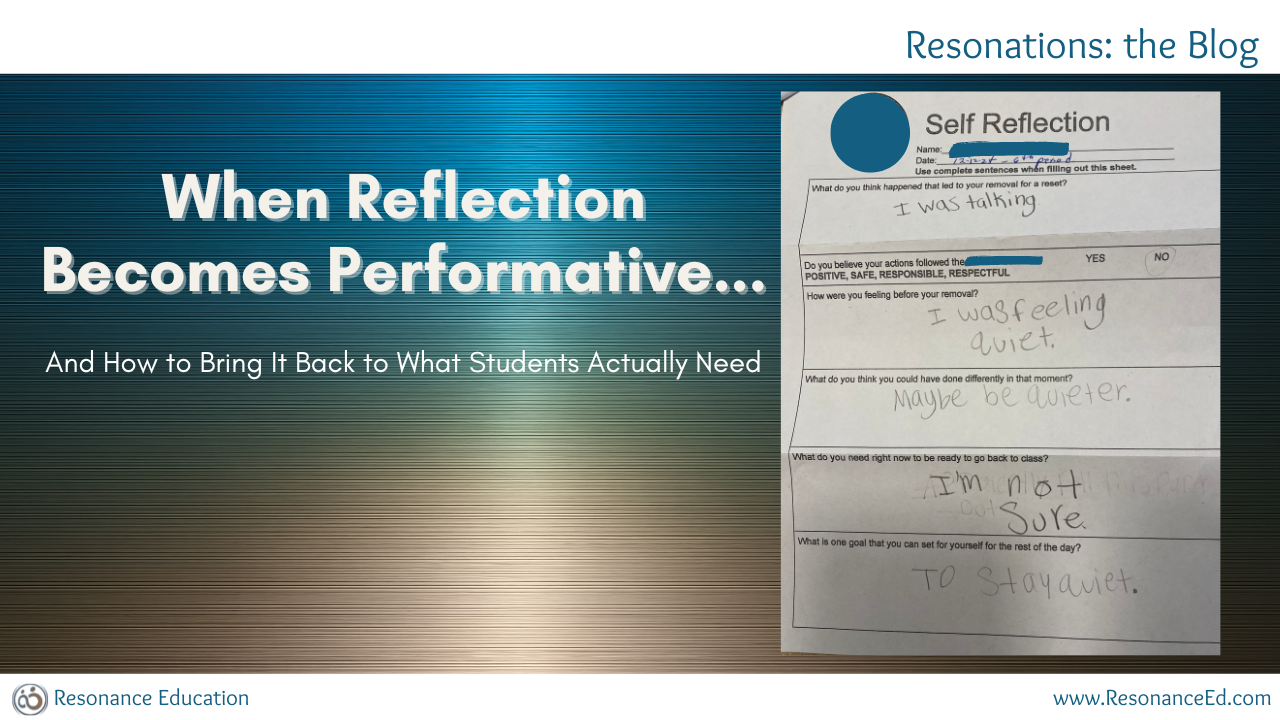
And How to Bring It Back to What Students Actually Need
I believe in restorative practices. I believe in reflection.
And I also believe we need to be honest about when our tools miss the mark.
Recently, I came across a student reflection sheet completed after the student was removed from class. On paper, it did everything it was supposed to do.
- What happened? “I was talking.”
- How were you feeling? “I was feeling quiet.”
- What could you have done differently? “Maybe be quieter.”
Then came the question meant to signal readiness and repair:
- “What do you need right now to be ready to go back to class?”
The student initially wrote: “Apparently fill out this paper.”
Then crossed it out.
And replaced it with: “I’m not sure.”
That erased and written-over response told the truth before the final one tried to comply.
The Gap Between Intention and Impact
Reflection sheets are often designed with good intentions:
- Encourage accountability
- Slow students down
- Create space for self-awareness
But when students experience them as hoops to jump through, reflection becomes performative. The student learns:
- Say the right thing.
- Finish the form.
- Get back to class.
The student doesn’t learn:
- Understand myself.
- Repair harm.
- Build a plan that actually helps me succeed next time.
When a student writes “I’m not sure,” they’re not being defiant. They’re being honest.
And honesty is where restoration actually begins.
Moving Reflection From Performative to Meaningful
So how do we shift reflection from something done to students into something done with them? Here are a few ways to start.
1. Replace “Right Answers” With Real Options
Instead of asking an open-ended question that students don’t yet have the skills to answer, offer scaffolds. For example:
Right now, I might need…
☐ a few minutes to cool down
☐ help putting words to what I’m feeling
☐ a plan for what to do if this happens again
☐ a quick check-in with an adult
☐ something else: __________
This raises the likelihood of an honest response.
2. Treat “I’m Not Sure” as Data Instead of Failure
When a student doesn’t know what they need, that tells us something important:
- They may lack emotional vocabulary.
- They may still be dysregulated.
- They may not feel safe enough yet to reflect.
That’s the signal to slow down the process, not end it.
Reflection is not effective when regulation hasn’t happened first.
3. Pair Paper With Conversation
A sheet can support reflection, but it should rarely replace a human interaction. An open, authentic conversation does more restorative work than any checkbox alone.
A simple follow-up like:
- Can you tell me more about that?
- What usually helps when this happens?
- What would make the next 10 minutes easier?
The relationship becomes the intervention.
4. Focus on Readiness Over Compliance
Being “ready to return to class” is not the same as being quiet or finishing paperwork.
Readiness might mean:
- Devising a strategy for the next trigger
- Feeling seen and understood
- Identifying a trusted adult to help during future moments
- Having repaired a relationship
When we equate readiness with compliance, we miss the learning.
5. Use Reflection as Skill-Building
The goal of restorative reflection isn’t to decide: “Are you ready or not?”
It’s to help students practice self-awareness, self-management, and responsible decision-making. Those skills take time, modeling, and repeated support.
A single sheet cannot carry that weight on its own.
Why This Matters
Restorative practices lose their power when they become procedural.
Students can tell when reflection is about checking a box, protecting adult systems, or moving them along quickly. And they can also tell when it’s about care, growth, and repair.
When a student crosses out “apparently fill out this paper,” they’re naming the difference.
Our job is not to make reflection look restorative.
It’s to make it feel meaningful.
Real restoration doesn’t start with the perfect answer.
It starts with honesty, support, and the space to learn what you need next.