Recognize - Cultivate - Activate: 3 Phases for SEL Integration
Aug 09, 2026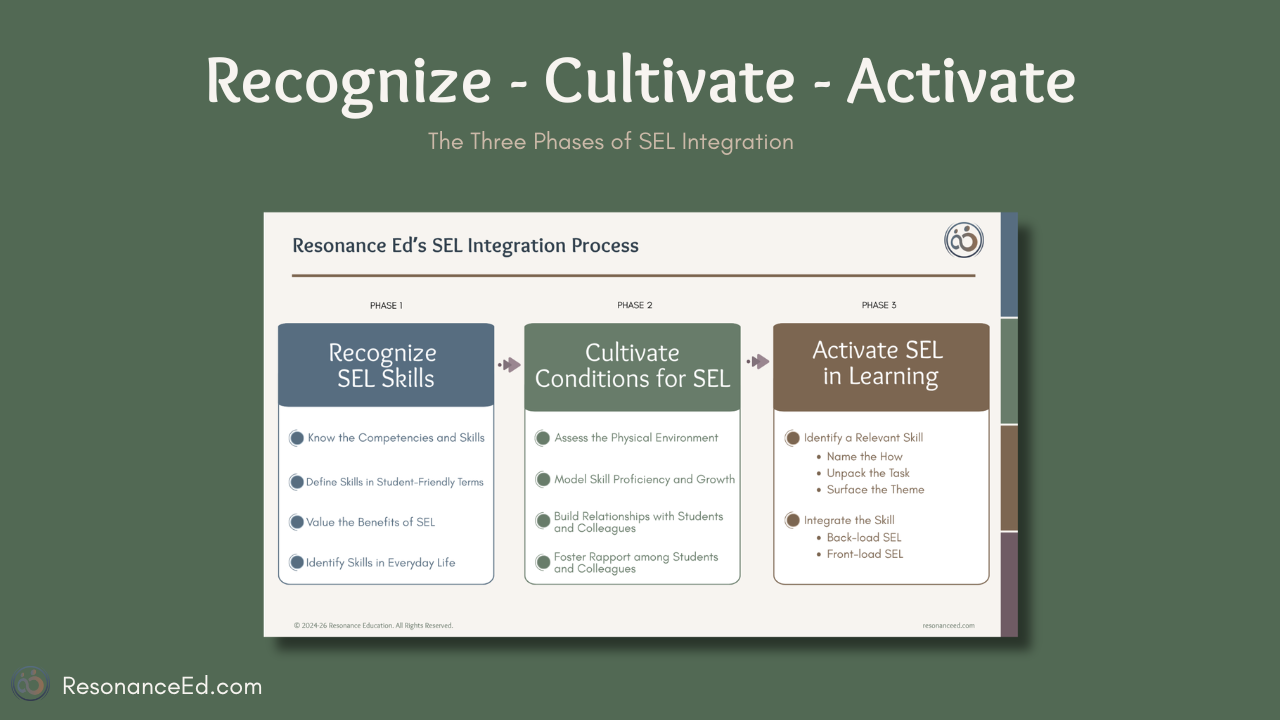
When I was working on the K-12 SEL Learning Targets, I spent a lot of time thinking about where students were going. A learning target's whole premise is the destination... if you can see where growth is headed, you can design toward it.
A parallel question kept pulling at me the whole time.
If I know where SEL development is going, I also need to know where it happens. Not the dedicated lesson. Not the advisory period. The real minutes of a real school day.
SEL starts with relationships... safety is the foundation, and students cannot learn what they do not feel safe enough to try. All of that is true. Relationships create the conditions.
The question I could not shake was: once those conditions are in place, what comes next? Where in the day does the skill development actually happen?
So I did what I tend to do. A colleague, Dr. Lori Stollar, and I created a list. We went back through years of classroom teaching and asked: where was SEL already showing up in my practice? Not in the lessons I'd designed around it on purpose, but in the everyday choices. The structures I returned to. The things I did because they felt right, without always knowing why.
The list organized itself. The part of a lesson where we asked students to name what they were noticing about themselves. The physical arrangement of the room. The discussion structures we used.
For a while, we called that list the Four Pathways for SEL Integration... four separate doors into the work, and an educator could walk through any one of them depending on where their students, and their own confidence, stood. That framing was useful, and many partners built strong practice on it.
The more I sat with the list, though, the more I realized it wasn't really four equal entry points. Recognizing a skill has to come before you can build the conditions for it, and building the conditions has to come before you can ask a student to use the skill inside a lesson. The physical environment and social interactions sit under the same umbrella, Cultivating Conditions for SEL. Instructional practices and curriculum both land under Activating SEL in Learning. So this summer, I rebuilt the framework around that order: three phases instead of four pathways.
The SEL Connection
Phase 1: Recognize SEL Skills. Before you can develop a skill in students, you have to be able to see it yourself. This phase is about knowing the competencies, defining them in language students would actually use, understanding why the skill matters, and noticing it already at work in everyday life... in the hallway, at home, on a team. You cannot nurture what you cannot name.
Phase 2: Cultivate Conditions for SEL. This is where safety gets built. It includes the physical environment... what's on the walls, how the furniture is arranged, whether students see themselves reflected in the room. It includes modeling: how you narrate your own growth as a learner of these skills, not just a teacher of them. And it includes relationships, with students and with colleagues. Rapport does not happen by accident. It is cultivated, on purpose, before you ever ask a student to take a risk in front of you.
Phase 3: Activate SEL in Learning. This is where the skill moves out of the room's atmosphere and into the actual task, and it happens in two moves.
(1) The first move is identifying which skill is relevant to the work students are about to do. Three routines get you there, depending on what's in front of you:
- Name the How treats the format of the work itself... independent, partner, or group... as skill practice.
- Unpack the Task reads the assignment directions the way you'd unpack a standard, verb by verb.
- Surface the Theme goes underneath the content to the human idea at stake... justice, identity, power, belonging.
Each one turns something you were already doing into a deliberate skill lesson.
(2) The second move is integrating the skill into the lesson itself, and there are two ways in:
- Back-loading is the simpler of the two, and usually the right place to start if you're new to this work. You teach the lesson you already planned, then afterward hand students the choice: they pick and name the skill they practiced.
- Front-loading is the fuller cycle. You build a shared definition of the skill with students before the task, prime it right before, and close with reflection... judging how well the skill was used, not just naming it.
One is the entry point. The other is where the practice matures.
Why This Matters
I want to be honest about why the shift from four pathways to three phases matters, and it is not cosmetic.
Four pathways, presented as a flat list, can read like a menu... pick the one that feels easiest and call it a day. I've watched partners do exactly that. A room gets a calming corner, the physical environment box gets checked, and nothing else in the practice changes. That was never the intent, but a list of equal options invites that reading.
Three phases, in sequence, don't allow that shortcut. You cannot activate a skill inside instruction if you haven't cultivated the conditions for a student to try it safely. You cannot cultivate conditions around a skill you haven't first recognized and named for yourself. The order is the argument: SEL integration is not a collection of separate initiatives. It is one continuous move, from recognition to condition to action.
This is also why SEL isn't a program; it's a practice. A program hands you content and a script and tells you which weeks to run them. A practice asks you to notice where you already are in the sequence... which phase is solid in your classroom, and which one you've been skipping past.
Reflection
As you think about your own classroom or building: which of the three phases is already strong in your practice, without you having named it that way? And which one have you been skipping... moving straight from recognizing a skill to expecting students to use it, without doing the work of cultivating the conditions in between?
Want the Try Tomorrow strategies and free resources delivered straight to your inbox? Join the Resonance Education newsletter at resonanceed.com/sel-resources.