Grass Remembers: The Patterns Students and Staff Keep
Aug 18, 2026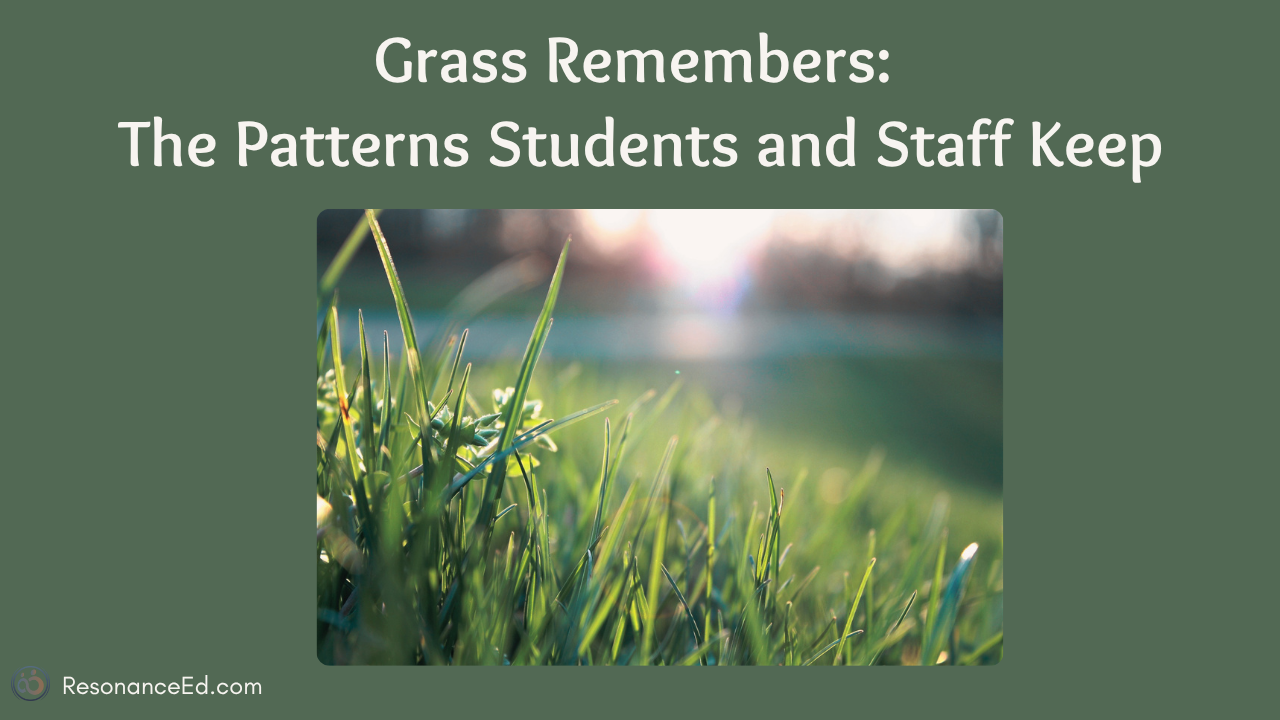
In college, summer breaks meant working alongside my father, a landscaper. My brothers, my sister, and my mom placed bets on how long I'd last. Manual labor, scorching heat, long pants, dirt under my nails. Nobody in my family gave me more than a few weeks.
I surprised them all. I worked with my dad every summer through college, and I loved it. I loved the feeling of immediate results, the kind you almost never get in a classroom. I loved the time with my dad. I even loved the hum of the mower, the rhythm of weedwacking, and the quiet lessons I absorbed along the way... lessons that had very little to do with grass and everything to do with life.
One of those lessons has stuck with me for nearly three decades, rooted in the very blades of grass.
What "Grass Memory" Means
The phrase "grass has memory" sounds like something you'd cross-stitch on a pillow. Spend a season behind a mower, though, and you watch it happen. It shows up in two ways.
- Directional memory. Grass blades lean the way they have been mowed. Cut the same pattern week after week, always lengthwise, and the blades start to bend and grow in that direction. This is why anyone who takes lawns seriously will tell you to change it up: diagonal one week, widthwise the next, lengthwise after that. Varying the pattern keeps the blades standing straighter and keeps the mower's wheels from rutting the same strips of ground every pass.
- Stress memory. Grass also holds onto where it has been under stress. Leave a kiddie pool or a lawn chair in one spot too long and the soil underneath compacts. Even after you move the chair, that patch struggles to come back, because the problem is no longer the chair. The problem is the ground. A lawn that has gone through drought or dormancy can look completely finished, and with the right conditions and enough patience, it comes back anyway.
Two kinds of memory: One shaped by the pattern you repeat, the other shaped by what it has endured.
The SEL Connection
I still mow my own yard, and I still like it. It takes me back to those early mornings with my dad, the smell of fresh-cut grass, the immediacy of seeing something change because you showed up and did the work.
We lean toward our patterns. The habits we repeat shape the direction we grow, and most of the time we do not notice it happening.
We also carry the memory of our stresses, our obstacles, and our dormant seasons. It is how we are built.
Our students are built the same way, and a classroom holds both kinds of memory.
- Students lean into the patterns they experience. How we greet them at the door. The routines we set in the first two weeks. Whether feedback arrives as correction or curiosity. What actually happens after a mistake. These are not one-time events; they are patterns that bend growth in a direction.
- Students also carry stress memory. Past academic struggle. A hard year socially. A label that followed them from one building to the next. These all leave compacted spots. A student who will not start an assignment is often not refusing the assignment. They are protecting themselves from a pattern they already lived through. The lawn chair is gone, but the ground still remembers.
If we always approach students from the same angle, they only grow one way. Not because they are limited, but because that is the only direction we have given them.
Why This Matters
I want to revisit the mowing pattern piece because it is the part educators can control immediately, and the part we tend to overlook.
Most of us have a default angle. Mine is story. In my newsletters (Teaching that Resonates and Leading that Resonates), I open with one almost every time I write, and almost every time I stand in front of a room, and I am good at it.
I also know exactly where it fails, because I have been on the other side of it. I have read pieces and sat in sessions where the story kept unspooling, and I caught myself scanning ahead for the research, wanting the connection, thinking, “Just tell me what this is FOR.” I know that impatience from the inside. Educators in every room are that version of me; they might not be disengaged during the story, but they are waiting for the why or the how.
I still lead with a story, because it is my angle. For a long time, I didn't think of it as an angle at all. I thought of it as consistency. Consistency in routines and expectations is not the same thing as sameness in approach. We all need consistency to feel safe. Over time, sameness wears into ruts.
Varying the pattern means varying how students access a skill, not lowering what we expect of them. It means a class that co-constructs what social emotional learning skills look and sound like on Monday might practice it through a written reflection on Tuesday, through a partner protocol on Thursday, and through a self-assessment on Friday. Same skill. Different angles. The blade grows straighter because it was never pushed the same way twice.
The stress memory piece asks something different of us: patience, and a willingness to work the soil instead of the surface. When a student's confidence has been compacted, encouragement alone does not decompact it. What helps is fresh conditions: a new grouping, a task with genuine choice, a chance to demonstrate a skill in a context where they have no history of failing.
Recovery is real, and it happens on the grass's timeline, not the landscaper’s.
This is also why SEL cannot be a unit you teach in September and check off. Nobody aerates a lawn once and declares the soil fixed. SEL isn't a program; it's a practice.
The pattern is the intervention.
I want to be honest about the limit of the metaphor, too. Grass does not have a say in how it gets mowed. Students do, if we are willing to listen. The most useful thing we can do with all of this is not to quietly adjust our patterns on students' behalf, but to name the patterns out loud with them and let them tell us which angles are working.
Ask a class what helps them start hard tasks. They will tell you. Most have never been asked.
Reflection
As you head into this school year, sit with these:
- What patterns are you creating right now that your students will remember and grow toward?
- Where in your classroom are you mowing the same direction every week, and what would a different angle actually look and sound like?
- If you are an administrator, replace the word “students” in this with “staff.” How might that adjust your frame and actions?
The patterns you set early leave the longest impression.
Because grass remembers.
And so do they.
And so do we.
Want the strategies and free resources delivered straight to your inbox? Join the Resonance Education newsletter at resonanceed.com/sel-resources.